Modulox Drive Modulox Drive

Top 10 Permanent Magnet Motor Manufacturers in 2026

Time:2026-09-25 Author:Amelia
0%

The global Permanent Magnet Motor market is entering 2026 with stronger demand from electric vehicles, industrial automation, robotics, renewable energy, and high-efficiency appliances. Manufacturers now compete on more than rated power. Magnet quality, thermal control, acoustic performance, software integration, and supply-chain resilience also influence real-world value.

Professor K. T. Chau, a recognized expert in electric machines, has stated: “Permanent-magnet machines have the merits of high power density, high efficiency, and high reliability.” This principle guides our examination of the Top 10 Permanent Magnet Motor Manufacturers in 2026.

The ranking considers engineering capability, production scale, product diversity, global presence, research investment, and customer support. It also considers practical evidence, such as motor performance under heat, vibration, frequent load changes, and continuous operation. A polished datasheet is not enough.

A motor may look impressive on paper.

Field results can differ.

Some manufacturers lead in automotive traction systems, while others perform better in factory automation or compact motion control. Their strengths are not identical. This matters to buyers choosing motors for a specific duty cycle rather than a general application.

The market also faces unresolved challenges. Rare-earth magnet costs remain sensitive to geopolitical and supply pressures. Recycling systems are improving, but they are not perfect. Efficiency gains may increase manufacturing complexity. Buyers should question broad claims and verify testing conditions.

This guide offers a practical, evidence-based starting point. It is not a permanent verdict. Technology changes quickly, and a smaller specialist may outperform a larger brand in one demanding application.
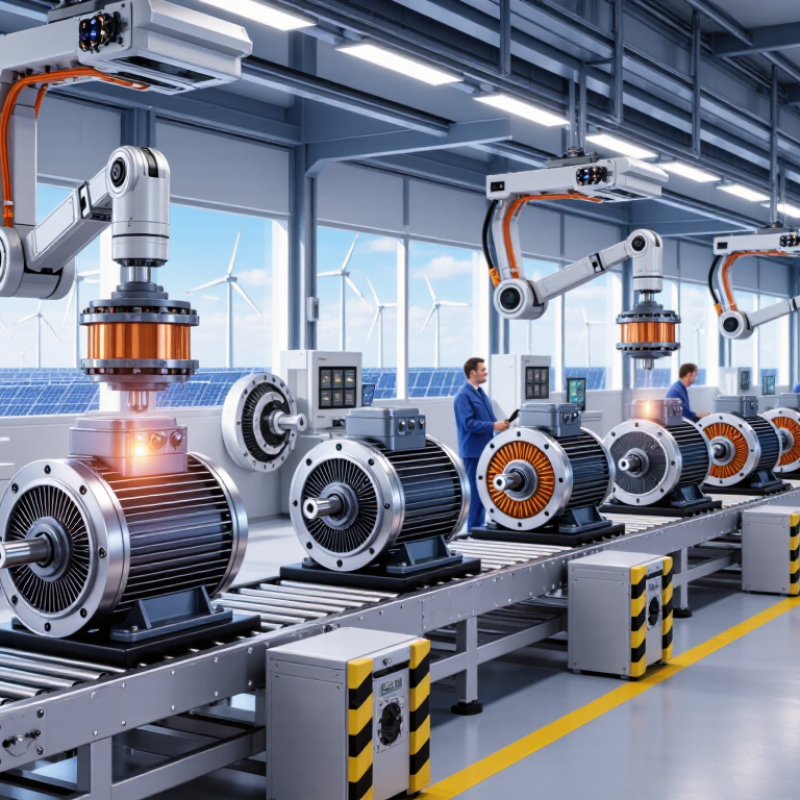
Top 10 Permanent Magnet Motor Manufacturers in 2026

Permanent-Magnet Motor Types: PMSM, BLDC, and PMAC Technologies

Top 10 Permanent Magnet Motor Manufacturers in 2026

Permanent-magnet motor types deserve closer attention than manufacturer rankings. PMSM, BLDC, and PMAC designs share permanent magnets, but their control methods differ. A PMSM usually uses sinusoidal current and delivers smooth torque with low acoustic noise. BLDC motors commonly use trapezoidal back-EMF and six-step commutation. They can simplify electronics, but torque ripple may increase. PMAC is a wider category, often using an AC inverter with surface or interior magnets. In practice, terminology is not always consistent. That can confuse procurement teams.

The International Energy Agency reported nearly 14 million electric car sales in 2023, representing about 18% of global car sales. This growth increases demand for efficient traction motors and reliable thermal designs. The U.S. Department of Energy identifies permanent-magnet machines as strong options for power density and efficiency. Yet rare-earth magnet supply, demagnetization risk, and inverter losses remain practical concerns. A higher efficiency rating does not guarantee better lifetime value. Installation temperature matters.

Tips: Match the motor to the duty cycle, not the brochure peak. Check continuous torque at real operating temperatures. Review controller compatibility, bearing life, ingress protection, and repair access. Ask whether the quoted efficiency includes the inverter. It often does not. Independent testing under IEC 60034 methods can improve confidence, although test conditions still deserve careful review. Some specifications look precise but hide assumptions. That is worth questioning.

Sources: International Energy Agency, Global EV Outlook 2024; U.S. Department of Energy, Electric Motor Systems Technology Review; IEC 60034 series.

IEC 60034-30-2: Why IE5 Motors Can Exceed 95% Efficiency

In 2026, permanent magnet motor manufacturers compete on efficiency, reliability, and measurable operating costs. IEC 60034-30-2 provides a recognized framework for classifying motor efficiency. It defines efficiency levels from IE1 to IE5 for applicable rotating AC motors. IE5 represents the highest listed class. Under suitable ratings and test conditions, some permanent magnet motors can exceed 95% efficiency.

The test conditions matter. Rated voltage, frequency, load, temperature, and measurement methods can change the result. At a test bench, a 95% motor loses only five units of input energy for every 100 units supplied. That distinction matters. Permanent magnet rotors avoid rotor copper losses. No rotor winding exists. However, inverter losses, bearings, air friction, and cooling fans still consume power. A motor may exceed 95% at rated load, yet perform differently during frequent starts or light-load cycles.

Published IE5 claims need context. Request test reports linked to IEC 60034-30-2, not only rounded marketing figures. Compare efficiency maps across 25%, 50%, 75%, and 100% load. Real factories rarely run at one point. This is where many comparisons become imperfect. I would also examine thermal limits, demagnetization resistance, encoder requirements, and service procedures. A well-designed motor should maintain stable performance beside a properly matched drive. Installation quality remains decisive. Misalignment, dust, and poor ventilation can erase expected savings. The label is useful, but never the whole story.

Ranking Criteria: Power Density, Reliability, R&D, and Global Production

Top 10 Permanent Magnet Motor Manufacturers in 2026

This 2026 ranking evaluates power density, reliability, R&D strength, and global production. It avoids sales volume alone. The IEA reports that motor-driven systems consume roughly half of global electricity, making efficiency a serious industrial issue. Power density is measured through continuous output, torque, cooling demand, and motor mass. Peak figures can mislead. A compact motor may overheat during repeated acceleration.

Reliability receives equal weight. We examine thermal cycling, insulation life, bearing protection, demagnetization resistance, and field-service records. The U.S. Department of Energy’s Motor Systems Market Assessment highlights major savings from efficient motor systems, especially in industrial equipment. However, laboratory efficiency does not guarantee factory reliability. R&D scoring considers control algorithms, magnet design, cooling methods, testing capacity, and documented patents. Patent counts alone remain imperfect evidence.

Tips: Ask for continuous power-density data, not only peak ratings. Request test results at your actual duty cycle. Check service coverage near the installation site.

Global production means more than having overseas distributors. Higher-ranked manufacturers should show multiple production locations, stable magnet sourcing, quality audits, and regional repair capability. We also review compliance with recognized motor-efficiency and safety standards. Some evidence remains difficult to compare because companies publish different test conditions. That weakness deserves attention. A transparent manufacturer should disclose temperature, speed, cooling, load profile, and measurement uncertainty. Without those details, even an impressive ranking can become partly subjective.

Top 10 Manufacturers: Products, Markets, Certifications, and 2026 Capacity

A useful 2026 comparison of permanent magnet motor manufacturers should look beyond headline power ratings. Product lines may include servo motors, traction motors, and compact units for pumps or compressors. Check each model’s torque range, speed limits, cooling method, and insulation class. These details affect performance in a real machine, not just on a specification sheet. Rotor material matters, too. Rare-earth and ferrite designs can differ in cost, temperature behavior, and supply risk. Small details matter.

Markets reveal where a manufacturer has practical experience. A supplier serving industrial automation may offer different testing and support than one focused on vehicles or household equipment. Certifications also need careful checking: request current documents and confirm they cover the relevant facility and product. ISO management certificates can indicate established processes, while market-specific product approvals may apply only to certain models. Do not assume one certificate covers an entire catalog.

For 2026 capacity, ask for monthly output, current utilization, lead times, and expansion plans. A large annual figure is less useful if tooling or magnet supply is constrained. Request evidence, such as recent production records or an agreed factory audit. Capacity figures are sometimes hard to compare. They may describe planned rather than proven output. That gap deserves attention. Buyers should weigh verified quality, delivery performance, and engineering response alongside price; no single ranking can fit every application.

Top 10 Permanent Magnet Motor Manufacturers in 2026 - Top 10 Manufacturers: Products, Markets, Certifications, and 2026 Capacity

An anonymized industry overview, not a verified company ranking. Profiles describe common supplier specializations; standards listed are relevant reference standards, not claims that a particular manufacturer or product is certified. Publicly comparable annual capacity figures are generally unavailable.

No. Anonymized Supplier Profile Representative Products Typical Markets Relevant Standards and Certifications to Verify 2026 Capacity Information
1 Large-scale industrial drive supplier Permanent-magnet synchronous motors (PMSMs), geared motors, integrated motor-drive systems Manufacturing, material handling, pumps, compressors, HVAC ISO 9001; IEC 60034 series; IEC 60034-30-1 efficiency classes; market-specific CE or UL requirements Company-level annual output not consistently disclosed in a comparable public format; confirm by plant and product line.
2 Electric-vehicle traction specialist High-speed traction motors, PMSMs, motor-generator units Passenger vehicles, commercial vehicles, hybrid and battery-electric platforms IATF 16949; ISO 9001; ISO 14001; applicable vehicle and functional-safety requirements (verify by program) Automotive capacity is commonly program- and plant-specific; public figures may refer to vehicle programs rather than motor units.
3 Servo and motion-control supplier AC servo motors, direct-drive motors, low-inertia PMSMs and matched drives Robotics, machine tools, packaging, semiconductor equipment, factory automation ISO 9001; IEC 60034; IEC 61800 series for adjustable-speed electrical power drive systems; applicable EMC requirements No standardized public 2026 capacity figure available for this anonymized profile.
4 Appliance and HVAC motor supplier Permanent-magnet fan motors, compressor motors, electronically commutated motors (ECMs) Residential and commercial HVAC, refrigeration, air-moving equipment, appliances ISO 9001; IEC 60335 product-safety requirements where applicable; UL 1004 series or regional equivalents where required Product-specific output is not reliably comparable across suppliers; request current plant-level production and lead-time data.
5 Small-motor and precision-motion supplier Brushless DC motors, miniature PMSMs, geared and coreless motor assemblies Medical devices, office equipment, consumer electronics, instrumentation, automation ISO 9001; ISO 13485 when supplying medical-device quality systems; applicable IEC/UL safety requirements Capacity varies widely by size, winding process and customization; no single public annual figure is applicable.
6 Heavy-duty and low-speed drive supplier Large-frame PMSMs, direct-drive motors, low-speed high-torque systems Mining, cement, metals, marine auxiliaries, water and wastewater infrastructure ISO 9001; IEC 60034; IEC 60079 where equipment is designed for explosive atmospheres; project-specific approvals Often engineered to order; capacity is better assessed through factory loading, project backlog and delivery schedules.
7 Renewable-energy generator supplier Permanent-magnet generators, direct-drive generators, wind-turbine generator assemblies Onshore and offshore wind, small hydro, distributed generation ISO 9001; IEC 60034; IEC 61400 series for wind energy systems; project and grid-code requirements Annual output depends on project awards and generator rating; a comparable public 2026 unit-capacity figure is not available.
8 Industrial pump and compressor motor supplier High-efficiency PMSMs, integrated pump motors, variable-speed motor packages Building services, process industries, water systems, oil and gas, refrigeration ISO 9001; IEC 60034-30-1; IEC 61800-9-2 for drive-system efficiency assessment; hazardous-area approvals where needed Public capacity figures are not consistently segmented by motor type; verify available monthly output and component sourcing.
9 Rail and transit traction supplier Traction motors, propulsion motor assemblies, auxiliary permanent-magnet machines Rail vehicles, metro systems, light rail, rail modernization programs ISO 9001; EN 50155 for electronic equipment in rolling stock where applicable; IEC 60034; customer and rail-network approvals Production is typically tied to multi-year contracts; public capacity should be interpreted alongside awarded programs and delivery commitments.
10 Custom and application-engineered motor supplier Custom PMSMs, frameless motors, torque motors, integrated motor-and-drive assemblies Aerospace subsystems, robotics, defense applications, specialist industrial equipment ISO 9001; AS9100 for applicable aerospace quality systems; product-specific environmental and safety requirements Low-volume, high-mix production is common; evaluate engineering throughput and qualified capacity rather than headline unit volume.

NdFeB Magnet Data: 1.0–1.45 T Remanence and Rare-Earth Supply Risks

Top 10 Permanent Magnet Motor Manufacturers in 2026

The 2026 market will reward motor manufacturers that understand magnet performance, not only production volume. NdFeB magnets commonly show 1.0–1.45 T remanence under specified test conditions. Higher remanence can support stronger torque in a smaller rotor. It does not guarantee better motor efficiency. Temperature, demagnetization resistance, air-gap design, and assembly accuracy also matter. A credible top-ten ranking should examine measured data, thermal testing, quality records, and field service evidence.

Rare-earth supply risk remains a practical engineering concern. Neodymium and dysprosium prices can change quickly after export controls, mine disruptions, or refining shortages. Manufacturers with several qualified material sources may respond better. Still, “multiple suppliers” can hide similar upstream dependencies. This weakness deserves more attention. Engineers should request traceability documents, batch certificates, and realistic lead-time records. A polished brochure is not enough.

In factory evaluations, small details often reveal process maturity. Check magnet coating thickness, rotor balance, adhesive curing, and temperature cycling results. Ask whether the stated 1.45 T value comes from a controlled sample or regular production. The distinction matters. Lower-grade magnets may reduce cost, but they can increase rotor volume and operating losses. I may be overvaluing laboratory figures here; long-term field data should carry greater weight. Supply planning should also include recycled magnet content, safety stock, and substitute-grade testing.

Top 10 Permanent Magnet Motor Manufacturers in 2026

NdFeB Magnet Data: 1.0–1.45 T Remanence and Rare-Earth Supply Risks

Typical remanence ranges vary by grade and manufacturer. NdFeB magnets offer high remanence, while their supply chain can be exposed to rare-earth sourcing and processing risks. This chart compares material-level ranges only; it does not rank or report data for individual companies.

FAQS

What does IE5 mean for permanent magnet motors?

IE5 is the highest efficiency class listed in IEC 60034-30-2. Some motors can exceed 95% efficiency under suitable conditions. Test conditions matter.

Why can these motors reach over 95% efficiency?

Permanent magnet rotors have no rotor windings. This avoids rotor copper losses. Inverter losses, bearing friction, air resistance, and cooling still reduce efficiency.

Does a 95% rating guarantee the same factory performance?

No. A motor may exceed 95% at rated load but perform differently during starts, stops, or light-load operation. Real factories rarely run continuously at one point.

Which efficiency data should buyers request?

Request test reports linked to IEC 60034-30-2. Compare results at 25%, 50%, 75%, and 100% load. Rounded figures are not enough.

What installation details can reduce expected savings?

Misalignment, dust, and poor ventilation can reduce performance. A matched drive and correct cooling are important. Small errors matter.

How should motor power density be evaluated?

Check continuous output, torque, cooling demand, and motor mass. Do not rely only on peak ratings. A compact motor may overheat during repeated acceleration.

Which reliability factors deserve close attention?

Review thermal cycling, insulation life, bearing protection, and demagnetization resistance. Field-service records are useful. Patent counts alone are imperfect evidence.

How can buyers compare production capacity fairly?

Ask for monthly output, factory utilization, lead times, and expansion plans. Check magnet sourcing and regional repair support. Planned capacity is not proven capacity.

Do certificates automatically cover every motor model?

No. Confirm that each current certificate covers the relevant facility and product. One certificate may not cover an entire catalog.

What information makes a manufacturer comparison more reliable?

Review actual duty-cycle tests, cooling methods, speed limits, service coverage, and quality audits. Rankings can help, but they remain partly subjective. The label is never the whole story.

Conclusion

This article presents a practical guide to the top 10 Permanent Magnet Motor manufacturers expected to shape the global market in 2026. It explains the main technologies, including permanent-magnet synchronous motors (PMSM), brushless DC motors (BLDC), and permanent-magnet AC motors (PMAC), highlighting their differences in efficiency, control, performance, and industrial applications. The discussion also introduces IEC 60034-30-2 and explains why IE5-class motors can achieve efficiency levels above 95% under suitable operating conditions.

Manufacturers are evaluated according to power density, reliability, research and development capabilities, production scale, certifications, market coverage, and projected 2026 capacity. The article further examines NdFeB magnet performance, including typical remanence values of 1.0–1.45 T, while addressing supply-chain uncertainty, rare-earth availability, and material cost risks. Together, these topics provide a balanced framework for comparing motor technologies and selecting efficient, durable solutions for industrial automation, transportation, renewable energy, and other demanding applications.

Amelia

Amelia

Amelia is a seasoned marketing professional with a wealth of expertise in our company’s core offerings. With an unwavering passion for driving growth and innovation, she plays a pivotal role in shaping our marketing strategies and enhancing brand visibility. A key aspect of her responsibilities......